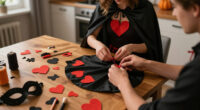
When a couple decides to dress up for Halloween together, the first real decision is not which characters to be — it is how to get there. Do you buy a pre-packaged couples costume kit, the kind sold everywhere from party stores to Amazon, where both halves of the costume arrive in one box already designed to match? Or do you assemble your own look from separate pieces, thrifted finds, and items you may already own? This is the decision almost every costumed couple faces, and it is more consequential than it sounds, because the two paths produce very different results and demand very different investments. The kit path is about guaranteed coordination and minimum stress: someone else has already made the creative decisions, and you just show up. The DIY path is about originality, fit, and the satisfaction of a costume nobody else at the party will be wearing — but it asks you to plan, shop, and execute, and it carries the risk that one partner ends up looking more polished than the other. For romantic couples specifically, there is an added layer: the costume is a statement about the two of you, and a mismatched or half-finished pair look can undercut the effect you were going for. This comparison walks through both options side by side across the criteria that actually matter — coordination, cost, effort, fit and comfort, originality, photo appeal, and reusability — and tells you plainly which approach fits which kind of couple.

Get gifts for the two of you delivered free with Prime
- Fast, free delivery on millions of items
- Prime Video, Amazon Music and more included
- Member-only deals all year

8-Piece Moth and Lamp Couple Costume Set
- ✔ Set size: 8 pieces
- ✔ Fabric: 100% cotton
- ✔ Included items: Moth cape, antenna headband, red glasses, lampshade, long gloves, long socks, decorative string of lights, fixing rope

Halloween Moth and Lamp Couple Costume Set, 4 Pieces
- ✔ Pieces: 4
- ✔ Fabric type: Chiffon
- ✔ Care instructions: Dry clean only

King and Queen Couples Halloween Costumes for Adults
- ✔ Material: Polyester
- ✔ Fit: One size fits all
- ✔ Theme: King and queen with skeleton and card motifs
At a Glance
| Criteria | Matching Couples Costume Kits (pre-packaged) | DIY Assembled Couples Costumes | Winner |
|---|---|---|---|
| Coordination guarantee | Built-in — both halves are designed to pair | Not guaranteed — depends on your planning and execution | A |
| Upfront cost | $40–$100+ for the pair, all at once | $20–$150+ spread across multiple purchases | Depends |
| Time and effort required | Near zero — order, open, wear | High — planning, sourcing, fitting, sometimes sewing | A |
| Fit and comfort | Often cheap fabric, standard sizing, unflattering cuts | Usually better — real clothes in your actual sizes | B |
| Originality | Low — others may wear the same kit | High — a look nobody else will replicate | B |
| Photo and party impact | Solid if the theme lands, diluted if duplicated | Highest when done well; weakest link shows when done poorly | B |
| Risk of disappointment | Low effort but quality can disappoint on arrival | Higher — a bad DIY is worse than a decent kit | A |
| Reusability of components | Poor — costume-grade pieces rarely reused | Strong — most pieces return to your wardrobe | B |
8-Piece Moth and Lamp Couple Costume Set
This is the most complete couples costume in the lineup, and that is exactly why it earns our top spot. Where the 4-piece version gives you the bare bones of the moth-and-lamp concept, this set rounds it out with red glasses, long gloves, long socks, and — the differentiator — a decorative string of lights that makes the lamp half of the costume actually glow. At a dimly lit Halloween party, that lighting transforms a cute idea into a costume people photograph.The 100% cotton fabric and loose cape cut also make it the most comfortable choice for a long night. Compared with the chiffon 4-piece set, cotton is less prone to static cling and tearing, and it feels less like a disposable party accessory. The stretch-fit headband accommodates different head sizes without pinching.The tradeoff is small but real: the batteries are not included, so if you forget them, the lamp loses its glow and the costume loses its punch. We recommend ordering batteries at the same time. This pick makes the most sense for couples who want a costume that works straight out of the package with zero scavenging for accessories.
Pros:
- Complete 8-piece matched set with no extra accessories to hunt down
- Built-in decorative lights make the moth-to-flame concept visible at night
- Breathable cotton and a loose cape cut keep both wearers comfortable
- Stretch-fit headband suits different head sizes
Cons:
- Lights require batteries that are not included
- Loose cape fit offers little shape or structure
Best for: Couples who want a fully accessorized, party-ready matched set with a visual gimmick that works in the dark
Not ideal for: Anyone hoping for a fitted, tailored look — the loose cape silhouette dominates, and you must supply batteries
Bottom line: The most complete and comfortable way to wear the moth-and-lamp concept, provided you remember the batteries.
“The most complete and comfortable way to wear the moth-and-lamp concept, provided you remember the batteries.”
Halloween Moth and Lamp Couple Costume Set, 4 Pieces
Think of this as the streamlined version of our top pick: same charming concept, roughly half the pieces. You get the essentials — a chiffon moth cape, antenna headband, fabric lampshade, and a practical windproof rope to keep the lampshade steady — without paying for gloves, socks, and glasses you may never wear again. For couples who treat Halloween costumes as a one-night affair, that simplicity is a feature, not a compromise.The chiffon cape is the standout quality here. At roughly 67 × 29 inches, it drapes and flows in a way cotton cannot, which gives the moth half of the costume genuine movement when you walk or dance. Compared with the 8-piece set’s cotton cape, this one photographs more gracefully but feels noticeably more delicate.Two drawbacks deserve attention. The dry clean only care instruction means a spilled drink becomes a permanent souvenir, which matters for a party costume. And the listing provides no wearing instructions for the lampshade, so expect a few minutes of trial and error before heading out. Skip this one if you want glow-in-the-dark impact — without lights, the lamp reads best in well-lit rooms.
Pros:
- Covers the core moth-and-lamp concept at a lower piece count
- Lightweight chiffon cape drapes and moves beautifully
- Windproof rope keeps the lampshade secure outdoors
Cons:
- Dry clean only, awkward for a party costume
- No wearing instructions for the lampshade
- No lighting, so the lamp half reads flat in dark venues
Best for: Budget-minded couples who want the moth-and-lamp concept with minimal fuss and a flowy, photogenic cape
Not ideal for: Anyone wanting a washable costume, built-in lighting, or a full head-to-toe coordinated look
Bottom line: The smart choice for a one-night couple costume where flow and simplicity matter more than glow or accessories.
“The smart choice for a one-night couple costume where flow and simplicity matter more than glow or accessories.”
King and Queen Couples Halloween Costumes for Adults
If moths and lamps feel too whimsical, this set leans into classic gothic romance: a king and queen motif layered with skeleton and card symbolism. It is the most conventionally romantic option here — matching crowns of a metaphorical sort — while still landing firmly in Halloween territory thanks to the macabre detailing. Compared with both moth-and-lamp sets, this costume reads elegantly rather than playfully, which suits dressier parties and cosplay events.The machine washable polyester is a genuine advantage over the chiffon set’s dry-clean-only requirement — after a night of partying, it goes straight in the wash. The soft, breathable fabric also makes it wearable for extended evenings, closer in comfort to the 8-piece cotton set than to chiffon.But two caveats shape the buying decision. Most importantly, each package contains only one costume — buy two or the couple’s costume becomes a very confident solo act. And the one-size-fits-all design is inherently a gamble: it works reasonably for average builds but may hang awkwardly on shorter wearers or strain on broader ones. The included accessories (one for the king, a rose for the queen) are a nice touch, though the set is lighter on extras than our top pick.
Pros:
- Matching king and queen designs with skeleton and card motifs
- Soft, breathable polyester comfortable for long wear
- Machine washable — the easiest cleanup of the three
- Works for Halloween, cosplay, and dressier themed events
Cons:
- Package contains only one costume; couples must order two
- One-size-fits-all fit may not flatter all body types
- Fewer accessories than the 8-piece moth set
Best for: Couples who want a darker, elegant matched look that washes easily and works for cosplay beyond Halloween
Not ideal for: Couples who assume one purchase covers both people, or anyone outside average one-size proportions
Bottom line: The most romantic and lowest-maintenance pick here, as long as you remember to order two.
“The most romantic and lowest-maintenance pick here, as long as you remember to order two.”
As an Amazon Associate we earn from qualifying purchases.
Key Differences
The single biggest difference between the two options is where the risk sits. A couples costume kit concentrates all of its risk in quality, not execution: you know the two costumes will match, but you do not know how the fabric will feel, how the sizing will run, or how flattering the silhouette will be until it arrives. A DIY costume concentrates its risk in execution, not quality: you control the materials and the fit, but nothing guarantees the two halves will read as a pair — or that either half will read as anything at all — unless you plan carefully. Couples consistently underestimate one of these risks depending on their temperament: organized crafters underestimate how much time a two-person costume eats, and last-minute shoppers underestimate how bad a cheap kit can look under party lighting.
The second major difference is what the costume says. Romantic couples costumes are, functionally, a public statement about the relationship — vampire and victim, Bonnie and Clyde, angel and devil, or something more personal like a couple’s shared inside joke rendered in costume. Kits cover the well-known pairings well; there is a reason every store stocks the same ten couples themes. But the most memorable couples costumes — the ones that get photographed and shared — are almost always personal: a theme that references how the couple met, a shared hobby, or a twist on a classic pairing. That kind of specificity is impossible to buy in a box, which is why DIY wins the impact category despite its higher risk.
The third difference is economics. A $70 kit is worn once and lives in a closet forever. A $90 DIY budget often buys real clothing — a dress she wears again, a blazer he keeps — which means the true cost per wear can be far lower, even when the sticker spend is higher. The kit is cheaper only if you genuinely value the convenience; if you compare like for like on materials, kits are usually the worse deal.
Detailed Comparison
Coordination guarantee (Matching Couples Costume Kits (pre-packaged) wins — major)
This is the kit’s home turf and its main selling point. A couples kit is designed as a pair from the start: colors, styles, and accessories are chosen to work together, and there is no risk of one partner showing up in a precision-crafted costume while the other looks like an afterthought. DIY coordination depends entirely on the couple’s planning discipline. The failure mode is real and common: one partner (often the one who proposed the idea) invests heavily while the other throws something together, and the pair look collapses. Couples can close this gap with a shared mood board, a written list of pieces, and a deadline — but that requires exactly the organizational effort that kit buyers are trying to avoid. Kit wins, and the gap is major for any couple where one person cares more than the other.
Upfront cost (moderate difference)
Kits typically run $40 to $100 for the pair, with premium licensed kits higher. That sounds predictable, but hidden costs add up: kits routinely exclude shoes, tights, makeup, and sometimes key accessories shown in the product photo, so the real total often lands 20–40% above the sticker. DIY costs are variable by design — a thrift-store duo can come in under $30, while a detailed build can exceed $150. The practical difference is that DIY lets you set the budget and trade money against time, while the kit fixes the price but hides the extras. For couples on a tight budget who own decent base clothing, DIY is almost always cheaper; for couples who would need to buy everything anyway, the gap narrows to a minor difference. On balance this one depends on your closet.
Time and effort required (Matching Couples Costume Kits (pre-packaged) wins — major)
No contest. A kit arrives complete: the total time investment is ordering, trying on, and possibly steaming out wrinkles. A DIY couples costume is a multi-week project in practice — ideation, sourcing across stores or platforms, coordinating two people’s pieces, test fittings, and usually a last-minute scramble for the accessory nobody bought. Realistically budget five to fifteen hours per couple depending on ambition, and understand that one partner usually absorbs most of that load. If your calendar in October is already packed, or if costume planning would become a source of friction rather than fun, the kit is not the lazy choice — it is the rational one. Kit wins, major gap.
Fit and comfort (DIY Assembled Couples Costumes wins — major)
Pre-packaged costumes are notorious for this. They come in generic S/M/L ranges sized to a hypothetical average body, made from thin polyester that tears at seams, traps heat, and photographs cheaply under flash. For a couple, this often means one partner gets an acceptable fit while the other spends the night uncomfortable. DIY built from real clothing uses your actual sizes, real fabrics, and pieces you already know you can wear for six hours. The comfort gap is one of the most underrated reasons to go DIY — Halloween parties involve standing, dancing, and photos, and an ill-fitting costume degrades all three. DIY wins, moderate-to-major gap.
Originality (DIY Assembled Couples Costumes wins — major)
Every store stocks the same couples kits, which means the most popular themes — angel and devil, plug and socket, famous movie pairs — are exactly the ones most likely to be duplicated at the party. If you and three other couples show up as the same vampire duo, the costume stops being a statement. DIY is original by construction: even a classic theme executed with your own pieces reads as distinct, and a personal theme (an inside joke, a shared memory) is unbuyable. The only caveat is that originality requires a good idea — an unrecognizable DIY is not original, it is confusing. But assuming competent execution, DIY wins this decisively.
Photo and party impact (DIY Assembled Couples Costumes wins — moderate)
This criterion combines originality with polish, which is why it is closer than it looks. A well-chosen kit photographs competently: the theme reads instantly, which matters for quick party photos. A well-executed DIY photographs brilliantly — better fit, better fabric, personal story. But a mediocre DIY photographs worse than a mediocre kit, because homemade flaws are visible in ways that kit flaws are not. The honest framing: kits deliver a reliable seven out of ten; DIY delivers either a nine or a four, depending on execution. Couples who know their own track record with craft projects should weight this accordingly. Slight edge to DIY, but only for couples who will actually finish the job.
Risk of disappointment (Matching Couples Costume Kits (pre-packaged) wins — moderate)
The kit’s disappointment risk is concentrated at delivery day: the costume looks cheaper in person than in the listing, the sizing runs small, or a seam fails. These are real but bounded risks, and ordering two to three weeks early with a backup plan neutralizes most of them. DIY’s disappointment risk is diffuse and larger: ideas that do not materialize, partners with unequal commitment, and the classic October 30th realization that the costume exists only as a Pinterest board. For risk-averse couples — or couples dressing for a high-stakes event like a themed wedding party or contest — the kit’s bounded, manageable risk profile is the safer bet. Kit wins, moderate gap.
Reusability of components (DIY Assembled Couples Costumes wins — minor)
Kit components are, with rare exceptions, single-use. Nobody re-wears a costume-grade cape to brunch. DIY components are usually real clothes: the dress goes back into her rotation, the vest into his, and accessories become reusable for future costumes or everyday wear. Over several Halloweens, a couple that builds a small wardrobe of versatile pieces progressively lowers the cost of every future costume. This is a minor criterion for one-off dressers but a major one for couples who costume annually. DIY wins.
Matching Couples Costume Kits (pre-packaged): Pros and Cons
Pros:
- Guaranteed coordination between both partners with zero planning
- Minimal time investment — order and wear
- Predictable, one-time cost with no hidden labor
- Ideal for popular themes that need instant recognition
- Bounded, manageable risk if ordered early
Cons:
- Cheap fabrics and unflattering generic sizing
- High chance of duplication at the party
- Rarely reusable after the night
- Hidden extra costs for excluded accessories and makeup
- No personal connection to the costume itself
DIY Assembled Couples Costumes: Pros and Cons
Pros:
- Originality — a look no other couple will have
- Better fit and comfort from real clothing in real sizes
- Components return to your wardrobe, lowering long-term cost
- Room for personal, romantic themes no store sells
- The building process itself can be a fun shared activity
Cons:
- Requires five to fifteen hours of combined effort
- Coordination can fail without disciplined planning
- Execution risk — a bad DIY is worse than a decent kit
- Unequal effort between partners can cause friction
- Cost can creep upward across multiple purchases
Who Should Choose What
Choose Matching Couples Costume Kits (pre-packaged) if:
- You are deciding what to wear less than two weeks before Halloween
- One partner is enthusiastic and the other is lukewarm — the kit removes the commitment gap
- You want a well-known theme (famous movie couple, classic angel-and-devil) where instant recognition matters
- You costume rarely and have no interest in building a dress-up wardrobe
- The event is casual and a competent, coordinated look is the entire goal
Choose DIY Assembled Couples Costumes if:
- You are dressing for a costume contest or an event where standing out matters
- You have three or more weeks of lead time and both partners will genuinely participate
- You want a personal or romantic theme — an inside joke, how you met, a shared obsession — that no kit sells
- You already own versatile clothing that can anchor the costumes
- You costume most years and want pieces you can reuse
Skip both if: You both actively dislike dressing up and are only doing it under social pressure — in that case, a minimal coordinated gesture (matching colors, matching masks, a simple themed accessory pair) beats forcing either a kit or a project neither of you wants.
Value for Money
Value here depends on what you are actually buying. A kit is not a clothing purchase; it is a convenience purchase. At $50–$80 for the pair, you are paying roughly $10–$15 per hour of saved planning and sourcing, which is a fair rate if your October is busy — and an overpayment if you have free weekends and enjoy the process. Judge kits on convenience, not materials, because on materials they are consistently poor value.
DIY inverts the equation: the money goes further ($60–$100 of real clothing beats $60–$100 of costume polyester every time), but you pay in hours. DIY is clearly the better financial value for couples who costume repeatedly, since each year’s build compounds into a wardrobe. It is also better value for couples who would enjoy the building as a shared activity — an evening spent thrifting together is part of the product, not a cost.
The one place paying more is genuinely worth it: premium licensed kits ($100+) are usually not worth the premium — you are still getting costume-grade construction at a markup. If you are going to spend over $100, spend it on DIY real clothing instead; the output will be better in every photo.
Final Verdict
For most couples reading this in mid-October, the matching kit is the right call: it guarantees the one thing a couples costume must have — that both halves visibly belong together — and it eliminates the planning load that turns fun into a chore. Choose the kit if your lead time is under two weeks, if your partner’s enthusiasm is uncertain, or if you want a recognizable classic pairing. Choose DIY if you have three or more weeks, both partners are genuinely invested, and you care about standing out — because the best couples costumes at any party are never boxed ones, and DIY also fits better, photographs better, and leaves you with clothes you can wear again.
The deciding factor is honest self-assessment, not budget: the question is not which option is better in the abstract, but which failure mode you can tolerate. If the worst outcome for you is a cheap-looking costume, go DIY. If the worst outcome is an unfinished costume, go kit. And whichever path you choose, commit to it together — a couples costume is the one outfit you cannot pull off alone.
Frequently Asked Questions
How early should we order a couples costume kit?
Order two to three weeks before Halloween. This leaves time to try everything on, return or exchange bad sizing, and buy the accessories kits typically exclude — shoes, tights, makeup. Ordering in the final week means accepting whatever arrives with no recourse.
What are the best DIY couples costume themes for beginners?
Start with themes built from near-normal clothing: a 1920s pair (vintage dress plus vest and slacks), tourist couple (Hawaiian shirts, cameras, sunscreen), or famous duo whose look is mostly streetwear. Avoid themes requiring props, makeup artistry, or sewing on your first build — those skills take a costume from weekend project to month-long production.
Can we mix approaches — one kit half and one DIY half?
You can, and it often works well: buy the harder-to-make half as a kit and build the simpler half from real clothes. The key is matching fabric quality and color closely, because the seam between costume-grade and real clothing is usually what makes a mixed pair look uneven. Do a full try-on together before the event.
How do we keep one partner from doing all the DIY work?
Split by task, not by costume: one person owns sourcing, the other owns assembly, or each person fully owns their own half against a shared written list. Set a hard deadline one week before the event for a complete test run. If one partner will not commit to their half, that is your signal to switch to a kit.
Are expensive licensed couples kits worth the extra money?
Usually not. Premium kits typically charge a licensing markup on the same costume-grade construction, so you pay more without getting better fabric or fit. If your budget exceeds roughly $100 for the pair, assembling real clothing yourself will produce a better-looking and more comfortable result for the same spend.